
A book at nine. A walk at thirteen.
The same twelve questions in both, so the second picks up where the first left off.
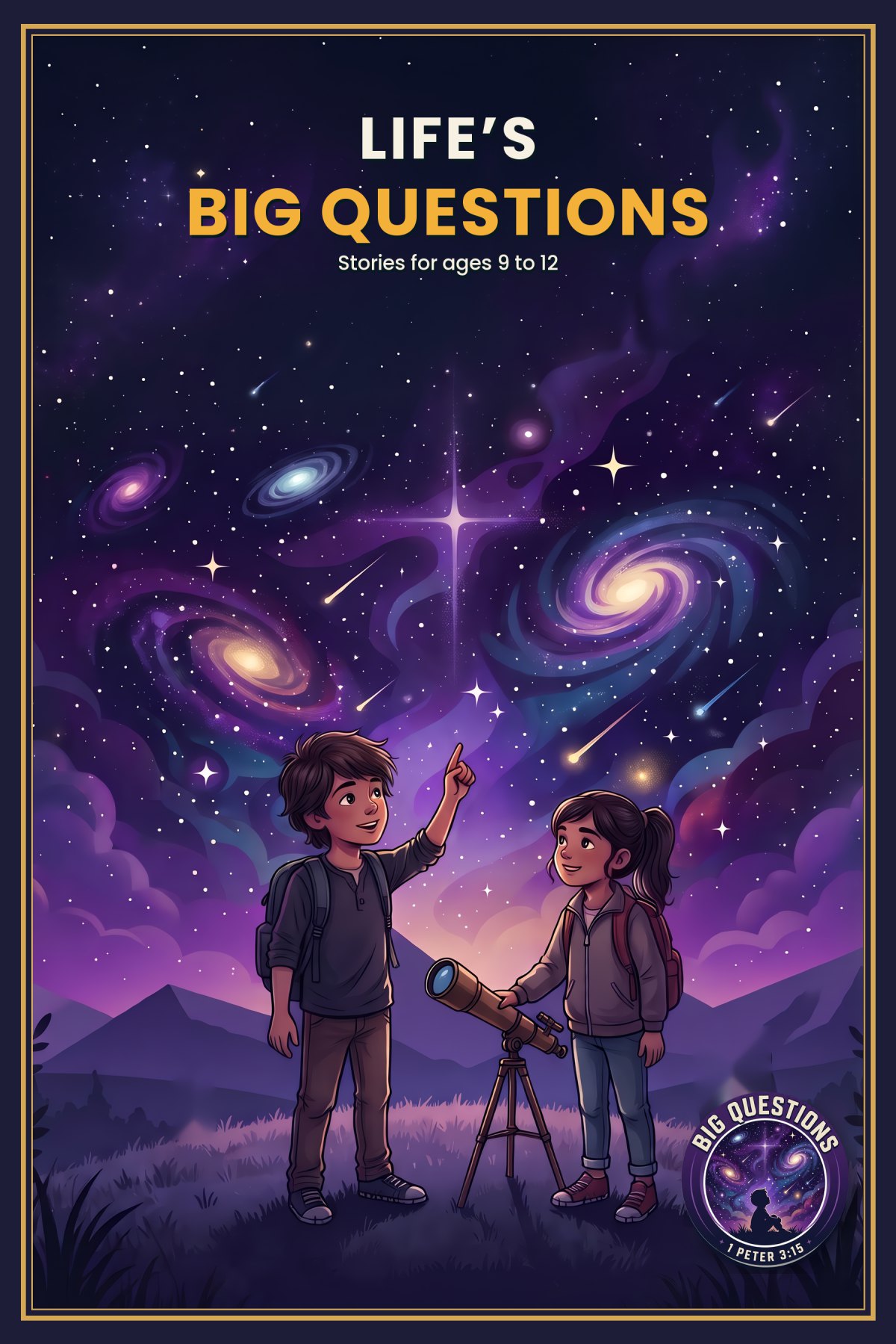
Life’s Big Questions
Twelve stories with Sam, Ruby and Jonah, one for each question, with what to talk about together.
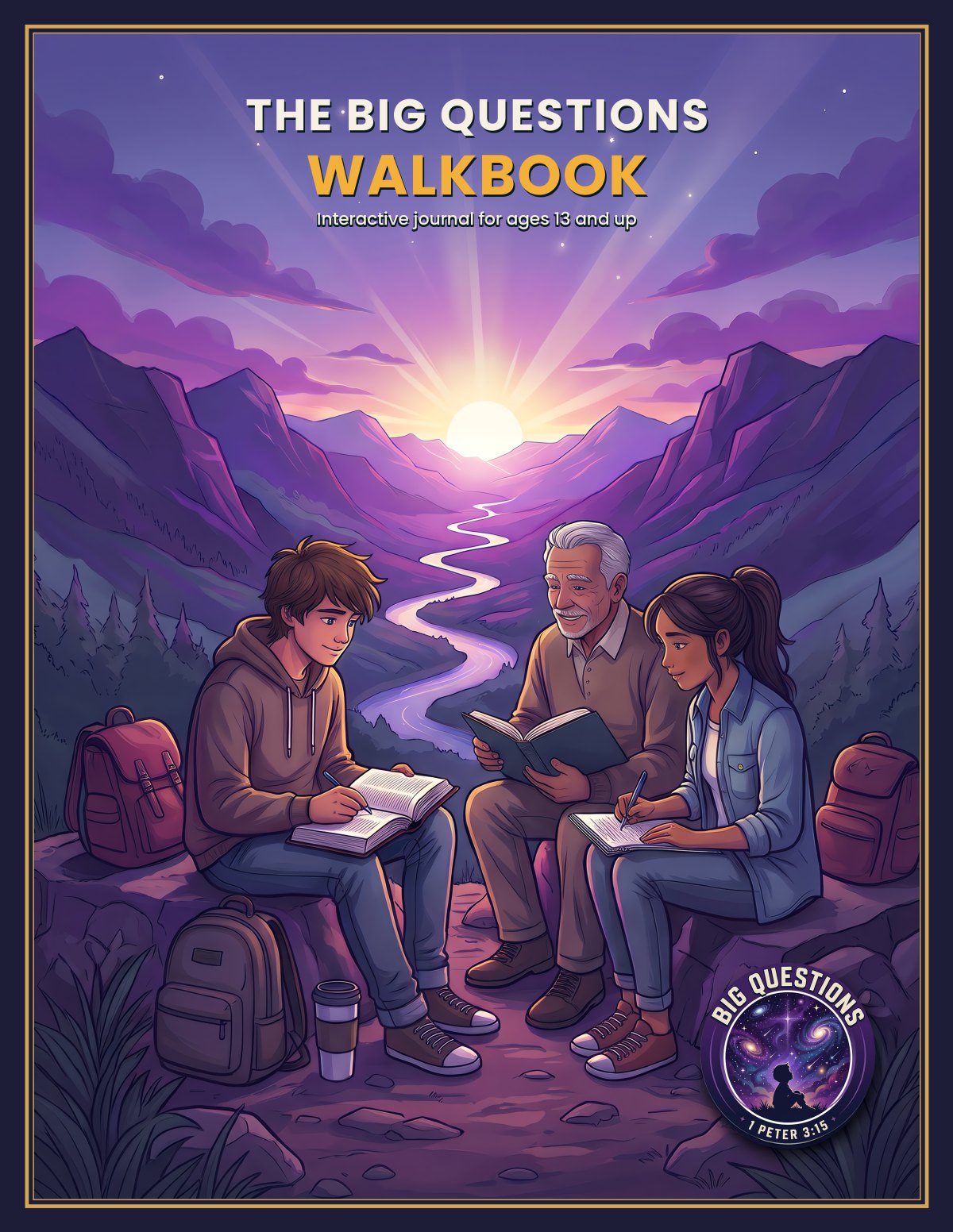
The Big Questions Walkbook
The Walk on paper: seven pages for each question, filled in with a mentor. Use it alone or beside the Walk online; the page numbers match.
The Walk
All twelve questions, in any order: the case from the Bible, what people say against it, and one honest sentence about where they stand. Online or in the Walkbook. Ages 13+.
The keepsake
Every question walked online, printed as a book: where they stood, their honest sentence, what the mentor saw. Free with the Walk.
Paradosis
A youth group or Sunday school program that hands the faith on, on purpose. A church with Paradosis covers every member who mentors.
Your family’s gate
One page with its own QR code: what your family has done, and an invitation to join you on Anvoy.
Cards, songs, posters, wristbands
Table Talk cards for the family table, a song for each question, a poster and wristbands. Not made yet.
Looking for something for 5 to 8? These questions are for nine and up. Straight Path starts at five.
Every student you mentor, every walk.
One mentor pass covers Big Questions and Straight Path, for every young person you walk with. A grandparent who joins your student’s walk with its code needs no pass of their own. A church with Paradosis ($99 a year) covers every member who mentors.
The Walkbook needs no pass: it works on its own, with a pencil.
The twelve questions
Every question is open from the start. Begin with the one they are asking now.
Creation or evolution? Real science, or biased science?
Whether everything made itself, and whether the people who say so are looking at the evidence or away from it.
Does God exist, and who is He?
Everyone believes something about where all this came from. Nobody starts out neutral. And if He is there, who is He?
If God is good, why evil and suffering, and the violence of the Old Testament?
If God is good and God is strong, why does it hurt this much? And why does the Old Testament read the way it does?
Is Jesus God, and did He rise from the dead?
A good teacher does not say what He said. Either He was lying, or mad, or He is who He claimed. The tomb decides it.
Why did Jesus have to die?
If God loves everyone, why a cross? Why not just forgive? Because forgiveness is never free; somebody always pays.
Is Christianity unique? One true faith, and the others?
Every religion cannot be true at once; they contradict each other about God, death and how to be saved. So which one?
Is the Bible God's Word? Is it accurate and reliable?
A book written over centuries, by dozens of people, on three continents, copied and translated, and it holds together.
Is there universal truth, and where does it come from?
Whether there is one truth for everybody, or only "your truth" and "my truth", and whether anybody can be good without God.
What is the meaning of life? Who am I?
Whether your life has a purpose that was there before you were, or only the one you make up; and whether you are more than your brain.
If God is loving, how can He send people to hell?
Whether a loving God can also be a judge, what hell is for, and what happens to people who never heard.
What happens when I die? Do I have an undying soul?
The one appointment nobody misses, and whether the one who keeps it is only a body.
If the church is God's, why so many hypocrites and denominations?
Whether the people who follow Jesus disprove Him, and why one Spirit has produced so many churches.
Starting a walk takes an Anvoy account — free, and yours to keep. A student joins with the code on the card their mentor gives them.
How a walk works
Start a walk
Their first name, the first question, who you are to them. With a mentor pass ($29 a year) or a church that has the Walk.
Give them the card
A card with their name, a six-letter code and a QR code. Print it, text it, or copy it. Anvoy sends nothing for you.
Seven pages, any order
Every question is seven pages, online or in the Walkbook, page for page. Take them in any order, more than one at a time.
Talk it over
Sit down together over each path, and the mentor signs it off. A grandparent far away joins with the same code.
Sign it off, keep it
You write what you saw in them; they write one thing to remember. Every signed question prints into the keepsake.
No AI on this walk
Nothing is written by an AI: not the case, not what you read about them. The sentence is theirs; the talking is yours.
What the page does
- Puts the case in front of them: three points, each a passage read whole from the Bible or a fact with its source, and asks whether they agree.
- Lists what people say against it, and the passage that answers each one.
- Asks where they stand, and for one honest sentence: I believe it because, I am not sure, and what would settle it is, I do not believe it because.
- Files their answer in their own My Beliefs, where it stays theirs, and keeps the trail of every time you meet.
What it never does
- Argue with the sentence once it is written. It is theirs.
- Tell them they are wrong. Not sure and I don’t believe it are real answers, and often the honest ones.
- Show their answers to anyone but their mentors, and for a student under 18, their family.
What you keep
Every question ends in a page of the keepsake: the case, where they stand, their one honest sentence, and a line for every time you meet. Here is an example, for Does God exist, and who is He?
Does God exist, and who is He?
- The sky is saying something, and everybody hears it. (Psalm 19:1-4) I lean toward it
- The made things show the One who made them; nobody is without a clue. (Romans 1:19-20) I affirm it
- Whatever is seen came from what is not seen: the universe had a beginning. (Hebrews 11:3) Still thinking
| Date | Where Sam stands | What changed |
|---|---|---|
| Oct 27 | Not sure yet | What a cause is; Hebrews 11:3 |
| Nov 3 | I believe it | Nothing cannot start anything |
No AI writes any of it: the passages are from the Bible itself, the sentence is the student’s.
One framework. This is one of its tools.
Life's Big Questions teaches twelve of the 100+ statements in Anvoy’s Foundational Values, in Life, Creator, Truth, Justice, Faith and Glory. Every walk names the statement it is about, and what the student answers lands in their own My Beliefs.
Straight Path teaches twelve more, in Character, Glory, Family, Work and Life.